Licensed massage therapy that we are all used to is about to have a problem in NYS. If policy in New York does not change, the massage profession as a whole faces a crisis like never before, with far-reaching economic impacts and public safety implications.
New York is losing licensed massage therapists faster than it can
replace them. Demand is growing. Supply is collapsing. And current
policy is accelerating the decline.
Data from: NY State Education Department, Office of the Professions · op.nysed.gov
The Numbers at a Glance
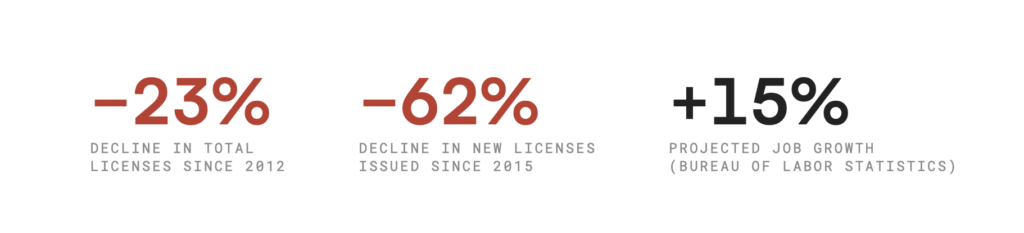
- Licensed massage therapists in New York State fell from a peak of 17,514 in 2012 to 13,571 in 2024 — a loss of nearly 4,000 practitioners.
- New licenses issued each year dropped from 751 in 2015 to 283 in 2024, a 62% decline, with a slight uptick to 307 in 2025.
- Demand for massage therapy is projected to grow 15% nationally, much faster than the average for all occupations.
- New York requires 1,000 hours of massage therapy education for licensure; most states require 500 to 750 hours.
- The Entry-Level Analysis Project found roughly 625 classroom hours are enough for safe, competent entry-level practice — New York requires nearly 60% more.
- Around 50 of those 1,000 hours must be in eastern massage modalities, which keeps New York off the national MBLEx exam and out of the Massage Therapy Licensure Compact.
What the Numbers Show about NYS Massage
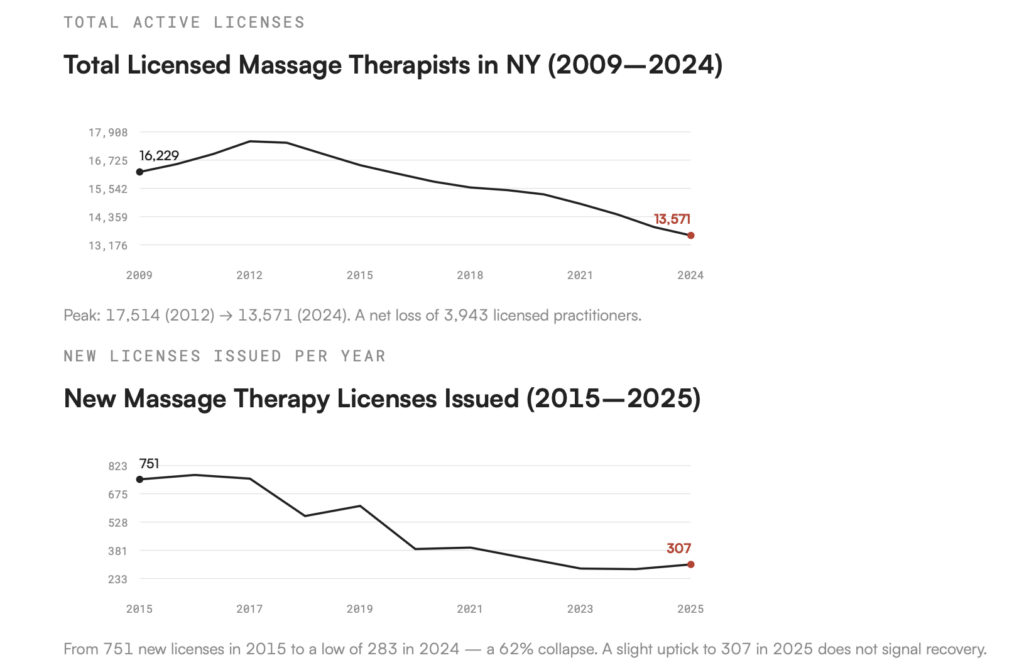
The total number of licensed massage therapists in New York State peaked at 17,514 in 2012 and has declined every year since, falling to 13,571 in 2024 — a loss of nearly 4,000 practitioners. More alarming: the number of new licenses issued each year dropped from 751 in 2015 to just 283 in 2024 — a 62% decline. A slight uptick to 307 in 2025 remains far below historical levels. The pipeline has collapsed. The total workforce will continue shrinking for years to come, even if reforms begin today.
Two trends, one conclusion: the massage therapy workforce in New York State is in free fall.
The Supply vs. Demand Gap
While New York’s licensed workforce shrinks, the Bureau of Labor Statistics projects that demand for massage therapy will grow 15% nationally — much faster than the average for all occupations. New York is heading toward a severe and widening labor shortage in a field that supports healthcare, tourism, and billions of dollars in economic activity. There has been a boom in the wellness industry that brings spas, bathhouses and wellness centers to NY and NYC.
Why It’s Happening to Massage in NYS
High barriers to entry, an isolated licensing system, and policy headwinds are driving the decline. NY massage policy states that its 1,000 hours are more ‘medical’ and represent a higher standard, but that is not necessarily the case. Our business regularly hires massage therapists and trains our staff for medical work; we have to train them because they are typically unprepared for this work by school. There are many highly trained LMTs in NYS, but that does not mean the school system is producing them.
- New York’s 1,000-Hour Education Requirement: New York requires 1,000 hours of massage therapy education for licensure. Most states require 500 to 750 hours. This means longer schooling, higher tuition costs, and more time before a student can begin earning a living. For prospective students weighing career options, New York’s requirements make massage therapy less accessible than in nearly any other state.
- Clock Hours ≠ Competency: New York’s requirements are based on clock hours, not competency. A student who completes 1,000 hours has sat in a classroom for 1,000 hours — but the system does not measure whether they actually acquired the skills. More hours do not necessarily mean more educated or more capable practitioners. They mean more time and money required to enter the profession.
- Research Says: 625 Hours Is Enough: The Entry-Level Analysis Project (ELAP), a national research initiative by the Coalition of National Massage Therapy Organizations (2013), found that approximately 625 classroom hours are sufficient to prepare graduates for safe and competent entry-level practice. New York requires nearly 60% more—with no demonstrated patient-safety benefit.
- The Eastern Massage Requirement: A Chain Reaction: Approximately 50 of New York’s required 1,000 hours must be in eastern massage modalities (shiatsu, tui na, etc.). Few other states mandate this. Because the MBLEx does not cover eastern massage — the national licensing exam used by most states — New York cannot adopt the national exam. Instead, New York must develop, administer, and grade its own state-specific licensing exam, driving up administrative costs. These 50 hours have no demonstrated impact on patient safety. But they are singlehandedly keeping New York isolated from the national licensing system. P.S. NYS should also stop calling it ‘Eastern Massage’. This single curriculum requirement creates a chain reaction:
- More required school hours for students, increasing cost and time to licensure
- A separate state exam that costs more to administer than the national standard
- Incompatibility with the Massage Therapy Licensure Compact, the interstate portability framework now being adopted across the country
The Cost of Education vs. Earning Potential
Massage therapy school in New York costs approximately $15,000 to $25,000 or more. With 1,000 hours required, NYS LMTS face longer education waits before they can work. Meanwhile, reported starting salaries are $40,000 to $55,000. For many prospective students, the financial math no longer works — and that’s before accounting for the policy threats to student loan access described below.
It is important to note, however: Massage Therapists are predominantly women. Many of those women are choosing this job precisely because they can work part-time and manage child care and family. Ie, the earnings may reflect choice, not actual potential. The numbers are likely additionally 20% or more higher due to poor reporting and tipped transactions, and many massage therapists are self-employed, meaning they use deductions to lower their earned income on paper. Once massage therapists move beyond ‘entry-level’, they often earn more.

In NYS, the Massage Education Pipeline is Collapsing
The 62% decline in new licenses issued is a direct reflection of fewer students enrolling in and graduating from massage therapy programs. As programs lose enrollment, schools close or shrink, which further reduces the pipeline. This is a self-reinforcing cycle: fewer graduates means fewer practitioners, which means less visibility for the profession, which means fewer students.
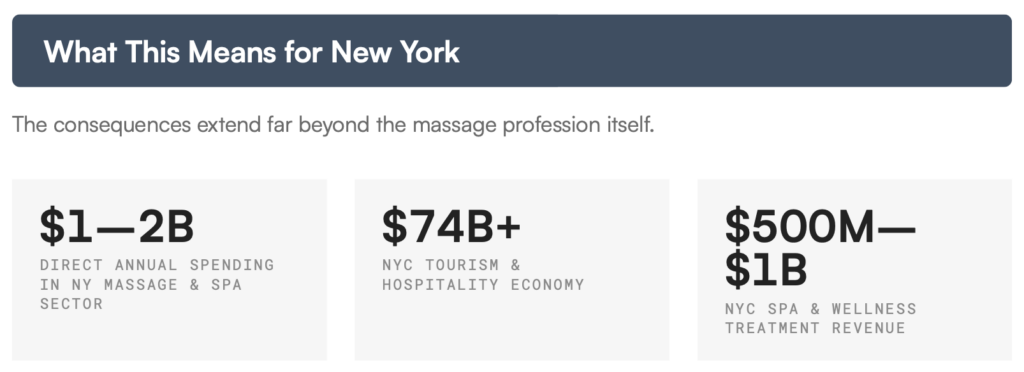
- Economic and Tourism Impact: The massage and spa sector represents roughly $1 to $2 billion in direct annual spending in New York. In Manhattan and the outer boroughs, hotel spas, luxury day spas, and wellness clubs drive an estimated $500 million to $1 billion in treatment revenue. This sector supports New York City’s $ 74+ billion tourism and hospitality economy. When spas and wellness businesses can’t hire enough licensed therapists, that revenue leaves the state or doesn’t materialize at all.
- Tax Revenue: Fewer licensed massage therapists means fewer people paying income tax, sales tax, and business taxes in New York. Every practitioner who doesn’t enter the profession — or who leaves for a state with lower barriers – represents lost tax revenue. As the workforce continues to shrink, this fiscal impact compounds.
- Public Safety and Unlicensed Operations: When there aren’t enough licensed therapists to meet growing demand, unlicensed operations fill the gap. This is already happening across New York. Untrained individuals are working on the public without health or safety standards, and the growth of unlicensed massage businesses often raises human trafficking concerns. A declining licensed workforce is directly connected to this problem — the very public safety issue that licensure was designed to prevent.
- Treating the Symptom, Not the Disease: A proposed state measure would create business-level licensing for spa owners, requiring establishments to hold a license to operate. While this would add a layer of oversight, it does not address the root cause: there are not enough licensed practitioners entering the profession to meet demand. Regulating businesses without rebuilding the pipeline of licensed therapists would treat the symptom, not the disease.
- Healthcare Access: Massage therapy is increasingly integrated into mainstream healthcare: pain management, post-surgical recovery, mental health treatment, and as a non-pharmaceutical alternative in the opioid crisis. Hospitals, physical therapy clinics, and the Veterans Administration are expanding their use of massage therapists. If New York cannot produce or attract enough licensed practitioners, it limits access to these healthcare services — particularly in underserved communities.
What is Coming Next for NYS Massage?
The Massage Therapy Licensure Compact is a multi-state agreement that makes massage therapy licenses portable across member states. For therapists, this means the ability to move or travel for work without re-licensing in each state. For states, it means access to a larger, more mobile workforce.
Could New York Join the Interstate Compact?
In theory, yes. In practice, the gap is significant. New York’s 1,000-hour requirement, mandatory eastern massage curriculum, and state-specific exam are all well above the Compact’s standards. Without meaningful reforms to these requirements, New York is effectively excluded from participation.
- Licensed therapists from other states cannot easily relocate to New York
- New York practitioners cannot take advantage of multi-state portability
- New York misses out on the economic and workforce benefits that Compact member states will enjoy
- As other states join the Compact, New York becomes increasingly isolated and less competitive for talent
The U.S. Department of Education’s proposed “Do No Harm” rule (AMTA summary) would restrict student access to federal financial aid for programs where graduates’ earnings fall below a certain threshold. On paper, this is meant to protect students from low-value programs. In practice, it threatens to cut off student loans for massage therapy programs nationwide.
As noted before, the problem is that the earnings data used to evaluate these programs is fundamentally flawed for massage therapy. If this rule takes effect using flawed earnings data, it will restrict the primary funding mechanism for massage therapy students at the exact moment when the profession needs more entrants, not fewer.
- Tips are often unreported. A significant portion of massage therapist income comes from gratuities that don’t appear in wage data.
- Many therapists work part-time by choice. The profession attracts people — primarily women who value the flexibility to work half-days and raise families. Part-time earnings look low in the data, but the hourly rate tells a different story.
- Cash-heavy work is undercounted. Many therapists are independent contractors or work in businesses where a portion of revenue is cash-based.
New York’s massage therapy workforce has been declining for over a decade.
The pandemic devastated the massage profession in 2020–2021, with new license issuance dropping to fewer than 400 per year. Unlike restaurants, retail, and other sectors that received targeted recovery support and eventually rebounded, the massage therapy workforce never recovered. New license numbers have continued to decline every year since, hitting a new low of 283 in 2024. A slight uptick to 307 in 2025 remains well below pre-pandemic levels. The industry received no comparable recovery investment, and the data shows it.
The Bottom Line: New York’s massage therapy workforce has been declining for over a decade. The pipeline of new practitioners has collapsed by 62%. Demand continues to grow. And every major policy development on the horizon — the Compact, the Do No Harm rule — will make the situation worse unless New York engages with these issues now. This is not a future problem. It is a current crisis that is getting worse every year.
Common Questions About the NYS Massage Therapist Shortage
There were 13,571 licensed massage therapists in New York State in 2024, down from a peak of 17,514 in 2012, according to the New York State Education Department, Office of the Professions.
Three reasons stack on top of each other: New York requires 1,000 hours of schooling when most states require 500 to 750, school costs roughly $15,000 to $25,000 against starting pay of $40,000 to $55,000, and the state’s eastern massage requirement keeps New York on its own licensing exam instead of the national one. Fewer people enter, schools shrink, and the pipeline keeps narrowing.
New York requires 1,000 hours, including approximately 50 hours in eastern massage modalities. Most states require 500 to 750 hours, and national research put the figure needed for competent entry-level practice at about 625 hours.
No. The Compact lets licensed massage therapists work across member states without re-licensing, but New York’s 1,000-hour requirement, mandatory eastern massage curriculum, and state-specific exam all sit outside the Compact’s standards. Without reform, New York is effectively excluded.
Fewer licensed therapists means longer waits for appointments, and it means more unlicensed operations opening to fill the gap. If you are booking, check that your therapist holds a current New York LMT license. Every therapist at Body Mechanics Orthopedic Massage is a licensed massage therapist, and we train our staff in medical and orthopedic work in-house.
Sources: NY State Education Department, Office of the Professions; U.S. Bureau of Labor Statistics (Occupational Outlook Handbook and OEWS, May 2024 and May 2025); Entry-Level Analysis Project (ELAP) Final Report, 2013, Coalition of National Massage Therapy Organizations; American Massage Therapy Association; Massage Therapy Licensure Compact.
Written by Beret Kirkeby, LMT, owner of Body Mechanics Orthopedic Massage in New York City. Body Mechanics hires and trains licensed massage therapists in Manhattan for orthopedic and medical massage work.