
If someone told you that part of your massage would happen inside your mouth, your first reaction would probably be:
“Wait…what?”
That’s completely normal. Actually, some people really need TMJ intraoral massage. If you suffer from jaw pain, it might be exactly what you need, and massage for jaw pain is supported by research.
Intra-oral massage is one of the most misunderstood forms of massage therapy. On that note, many do not even know it exists at all. It sounds intimidating, but in reality, it’s simply a way for a specially trained massage therapist to reach muscles that can’t be accessed from the outside of your face.
For people dealing with jaw pain, teeth grinding, clenching, headaches, facial tension, or difficulty opening their mouth comfortably, it can become an important part of a comprehensive treatment plan.
At Body Mechanics Orthopedic Massage, we use TMJ intra-oral techniques only when they’re appropriate—not because they’re trendy or dramatic, but because sometimes they’re the best way to reach the muscles and tension contributing to a person’s symptoms.
Here’s everything you should know before your first appointment.
What is intraoral massage?
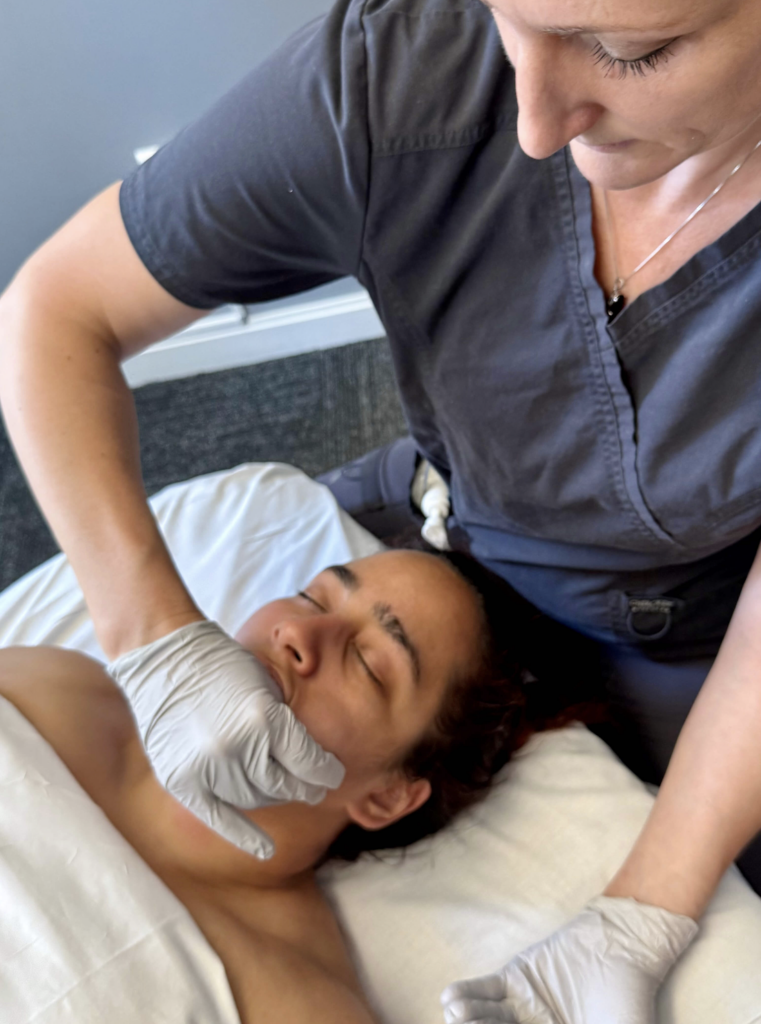
Intra-oral massage is exactly what it sounds like, its massage on the INSIDE.
Rather than treating muscles only from the outside of your face and jaw, your therapist also works inside the mouth while wearing medical examination gloves. When we say massage, we mean rubbing, holding, sliding, moving and more. This allows direct access to muscles involved in chewing, speaking, swallowing, and stabilizing the jaw. Many of these muscles are impossible—or very difficult—to reach externally.
That doesn’t mean everyone with jaw pain needs intra-oral work; some jaw pain can be entirely driven by cervical issues or shoulder issues. A quality assessment is needed to get understand what techniques might help you the most with your pain.
Why would someone get an intra-oral massage?
People usually don’t book an appointment because they want someone to work inside their mouth. They book because they’re tired of living with symptoms and they need help. Although recently ‘buccal massage’ has become trendy, so some may be familiar with it.
Some of the most common reasons include:
- Jaw pain
- Teeth grinding (bruxism)
- Daytime jaw clenching
- Pain while chewing
- Clicking or popping that’s accompanied by pain
- Limited jaw opening
- Facial muscle tightness
- Tension headaches
- Headaches associated with jaw muscle tension
- Neck pain that appears related to jaw dysfunction
- Pain around the temples or cheeks
- Ear ringing and fullness
Not every one of these symptoms comes from the muscles.
Sometimes the problem is primarily within the joint itself, the disc, arthritis, dental issues, cervical spine, shoulder or another medical condition.
That’s why assessment always comes first. If any of the symptoms start suddenly or do not resolve, a check-up is always in order.
What muscles are treated?
One of the biggest misconceptions is that TMJ massage only treats the jaw joint.
In reality, massage therapy primarily treats the muscles that influence how the jaw moves and its a lot of muscles.
Depending on your assessment, treatment may include:
- Masseter
- Temporalis
- Medial pterygoid
- Lateral pterygoid
- Buccinator
- Digastric
- Suprahyoid muscles
- Sternocleidomastoid (SCM)
- Upper trapezius
- Suboccipital muscles
- Cervical musculature
The jaw doesn’t function in isolation. Often in addition to the jaw muscles, the scalp muscles, the cervical muscles and the back are often treated. At Body Mechanics Orthopedic Massage, a one-hour massage is often upper body, with some time being spent on the back, and some on the neck as well. The face and jaw components may take 5-15 minutes, depending on the symptoms, and the intra-oral portion itself is quite short. For some it might only be 5 minutes.
If your seeing a physical therapist, you might ONLY have the immediate external jaw and intra-oral section treated. Due to the fact that manual therapy is billed in 15-minute segments for insurance.
Because jaw pain often has a stress-driven component, having a back massage is often really helpful in allowing the patient or client to self-regulate and reduce tension.
How is intra-oral massage performed?
Before any intra-oral work begins, your therapist explains exactly what will happen and asks for your permission.
Nothing is performed without your informed consent. It is slow, it is deliberate and you are in control.
Your therapist will:
- Wash their hands.
- Put on new medical examination gloves.
- Explain which muscles they’re treating.
- Tell you exactly where they’ll be working.
- Check in with you throughout treatment.
- Stop immediately if you ask.
Rather than forcefully digging into tissue, your therapist uses gentle, sustained pressure, small movements, or soft tissue techniques with movements that you control to address muscles inside the cheek. Communication is constant throughout the session. Yes you have a hand in your mouth but you will still be able to talk.
Does intra-oral massage hurt?
t is often not a walk in the park…But I have never had anyone who really needs it to regret it. And it should not be unbearable. It falls more in the discomfort zone.
Some muscles—especially the pterygoids or masseter—can be surprisingly tender as they are not used to being touched.
Most patients describe the sensation as:
- “That’s exactly the spot.”
- “Tender but relieving.”
- “A good hurt.”
- “OMG….but please do it to the other side now…”
Your therapist adjusts pressure based on your comfort.
If something feels too intense, simply say so. The goal isn’t to “push through pain.”
The goal is to calm and work under the nervous system’s threshold for alarm. No pain no gain is not a thing. If you saw the viral video of the intra-oral massage with LeAnne Rheims, it should not be like that.
Is there any recovery afterward?
Is there any recovery afterward?
Most people return to normal activities immediately. Some experience temporary soreness similar to what you might feel after exercise. Your therapist can advise on issues such as staying away from crusty bread or eating apples while you recover. It is totally possible to be sore after your treatment.
That soreness generally resolves within a day or two.
After treatment, we usually recommend:
- Staying hydrated
- Avoiding excessive jaw clenching and hard, irritating foods.
- Following any home exercises your therapist recommends
- Not testing your jaw repeatedly to “see if it’s fixed”
If you normally wear a night guard, continue using it unless your dentist advises otherwise.
Do therapists need special training?
Yes. 100% Yes. Do not see a therapist who is not trained in TMD.
Intra-oral massage requires additional education beyond general massage school.
A therapist must understand:
- Jaw anatomy
- Muscles of mastication
- Infection control
- Consent procedures
- Contraindications
- Safe intraoral techniques
- Advanced consent and safety protocols
Just because someone performs massage doesn’t automatically mean they’re trained to work safely inside the mouth.
When choosing a provider, ask whether they have specific education in TMJ or intra-oral techniques.
Are gloves worn?
Always.
In New York, intra-oral massage is performed using single-use medical examination gloves and follows appropriate infection-control procedures. These gloves should be put on just before the intra-oral part so that they are clean.
Gloves are changed between patients and discarded immediately after treatment.
Good hygiene isn’t optional—it’s a basic standard of professional care.
Is intra-oral massage legal in New York?
Yes.
New York allows licensed massage therapists to perform intra-oral massage when it falls within the legal scope of massage therapy and the therapist has appropriate education and training.
Some states have additional rules, restrictions, or require specific certifications for intra-oral work.Because massage laws vary across the United States, the requirements are not identical everywhere.
If you’re receiving treatment outside New York, it’s worth confirming that your provider is appropriately trained and licensed according to their state’s regulations. Please note there is no such thing as having a certification in TMD/TMJ massage. Massage therapists can hold certificates in training. Do not be fooled by fancy statements. We take the time to train our staff over many weeks and test messages. No one gets to dive right in.
Is intra-oral massage the same as buccal massage?
Not exactly.These terms are often used interchangeably online, but they aren’t the same.
Buccal massage generally describes treatment of the cheek tissues and is often marketed in esthetic or facial massage settings.
Intraoral massage for TMD is a clinical approach focused on improving jaw muscle function, reducing pain, and addressing muscles involved in chewing and jaw movement.
While there can be overlap in techniques, the purpose, assessment, and treatment goals are different. You can read more about the difference in our blog about TMD and buccal massage.
Can massage cure TMJ disorder?
No. There isn’t one treatment that “cures” every temporomandibular disorders.
TMD is an umbrella term that includes many different conditions affecting the jaw joint, muscles, and surrounding structures.
For some people, massage is one piece of a broader treatment plan that may also involve:
- a dentist
- an oral and maxillofacial specialist
- a physical therapist
- behavioral strategies for clenching
- a night guard when appropriate
- home exercises
- stress management
- acupuncture
- botox
Massage aims to reduce muscle tension, improve movement, decrease pain, and help you return to the activities that matter to you—it isn’t presented as a standalone cure. Current clinical evidence suggests manual therapy, including massage, may improve pain and jaw function for some people with muscle-related TMD, particularly when combined with education and exercise.
When should you avoid intra-oral massage?
There are times when intra-oral treatment should be postponed or avoided, including:
- Active oral infections
- Open wounds inside the mouth
- Certain recent oral surgeries (until cleared by your surgeon)
- Uncontrolled bleeding disorders
- Some acute dental emergencies
- When you or your therapist is sick
Your therapist will review your health history and determine whether intra-oral treatment is appropriate for you.
What should you expect at Body Mechanics Orthopedic Massage?
Every TMJ appointment begins with an assessment.We don’t assume that everyone with jaw pain needs the same treatment. Depending on your symptoms, your therapist may include:
- Neck treatment
- Jaw muscles
- Face and temples
- Shoulder muscles
- Home exercises
- Education about clenching habits
- Intra-oral massage when appropriate
Our goal isn’t simply to make your jaw feel better for an hour. It’s to understand what’s contributing to your symptoms and create a treatment plan that’s individualized to you. Most people see us on an ongoing basis for TMD/TMJ treatment.
Will My TMJ Massage Be Covered by Insurance?
Last but not least…this is always a very popular question! The answer is: possibly—but it depends on your insurance plan. If your working with a PT or other professional, they might be covered but not always. In that scenario, you may only be covered for the intraoral portion, not for any other massage, and due to TMD being a complex problem often influenced by stress, it’s actually better to have a more expansive treatment.
At Body Mechanics Orthopedic Massage, we are an out-of-network provider, which means we don’t bill insurance companies directly; you pay us. However, many clients are able to use their out-of-network benefits to seek reimbursement for medically necessary massage therapy.
If your plan includes massage therapy benefits, we’ll provide the documentation you need to submit your claim. It is, however, tricky in some regards. You may also need a prior diagnosis and a letter of necessity. Many people also find they have exhausted all treatment options before arriving at massage, so they have their referring doctor write a letter to explain we are the care providers needed, even if it is not typically covered.
If your plan includes massage therapy benefits, we’ll provide the documentation you need to submit your claim.
We Can Provide:
- A detailed receipt (superbill) for insurance reimbursement
- Your therapist’s New York State license number
- Documentation of the services you received
- Additional paperwork if required by your insurance company
Coverage varies from plan to plan, so we always recommend calling the member services number on the back of your insurance card before your appointment to ask:
- Do I have out-of-network massage therapy benefits?`
- Do you cover massage provided by a massage therapist?
- Is a doctor’s referral or prescription required?
- Is there a limit to the number of visits each year?
- What percentage of my treatment is reimbursable?
Many clients are pleasantly surprised to learn they have benefits they didn’t know existed.
Can I Use My HSA or FSA?
Yes. We accept both Health Savings Accounts (HSA) and Flexible Spending Accounts (FSA) for eligible services. Depending on your individual plan, these tax-advantaged accounts may allow you to use pre-tax dollars toward massage therapy. Some plans may require additional documentation or a Letter of Medical Necessity, so it’s always worth checking with your plan administrator.
If you have questions before your appointment, our front desk is happy to help you understand what documentation we can provide.
Ready to Stop Letting Jaw Pain Run Your Day?
Whether you’re dealing with clenching, teeth grinding, headaches, or persistent jaw pain, our therapists can help determine whether intra-oral massage is appropriate for you.
At Body Mechanics Orthopedic Massage, every treatment starts with an assessment—not a routine. We use evidence-informed techniques, communicate throughout your session, and tailor care to your goals.
Book your TMJ Massage appointment at our Manhattan locations and let us help you get back to eating, talking, laughing, and living more comfortably.
More questions? Quick FAQ for TMD intraoral massage
NO!
Along the side of the teeth aimed at the back of the mouth, under the cheekbone
You need to be employed by us for 6 months to a year before starting training. Then you need to take a course in safety, consent, and techniques, and complete multiple practice sessions with a test.
No. We have about half of our staff trained for this.
It depends. We would likely be working externally and on compensatory issues.
It depends. Many see us once every two weeks, but once a month or only when problems flare is normal too.
Yes, your therapist should work with you.
Book under TMD and your therapist can split the time:)
More reading
- TMJ Intraoral Massage: What It Is, How It Works, and What to Expect
- Prenatal Massage vs Regular Massage: Safe, Targeted Relief for Pregnancy in NYC
- Lymphatic Drainage Massage vs. Regular Massage: What’s the Difference?
- How Do You Know If You Need Lymphatic Drainage Massage?
- Sports Massage vs Physical Therapy: What’s the Difference? A Guide for New Yorkers